Delacco
+385 91 25 50 100 sales@delacco.com
Final testing phase: this online store is being tested. Quotations and orders generated during this period are provisional — our team will personally confirm each one by email before anything becomes binding.
Back to catalog

Semi-Electric Stackers

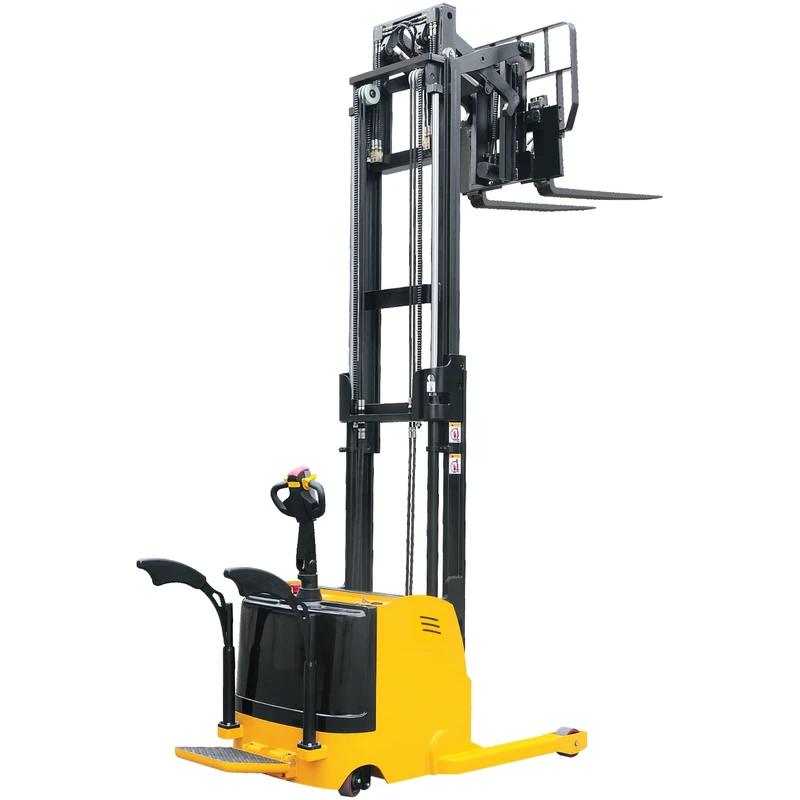
Semi-electric stackers with powered lift and manual travel — an economical entry into powered pallet stacking up to 3.5 m.
3 products

How to choose

What it is for

  1. Electric lift, manual push — stacking to ~3.5 m where travel distances are short.
  2. Small warehouses, workshops upgrading from manual.

Check before you choose

  • Capacity and lift height
  • Pallet type (straddle option)
  • Travel distance short enough to push by hand

Not suitable for

  • Long routes, ramps, multi-shift

What we will ask you before recommending a model

Semi-electric stacker Technical check — we confirm a few parameters and compatibility with you before the order.
  1. Heaviest load including pallet, packaging and any attachment? Rule of thumb: use at most 80 % of rated capacity for safety and service life.
  2. How high must the load be lifted — top rack beam, vehicle bed, machine table? How many rack levels? Capacity at maximum height is much lower than nominal (residual capacity). Customers know 'the rack', not millimetres — ask them to measure the top beam.
  3. Is the load always on a EUR pallet (open bottom)? Or CHEP / closed-bottom / plastic pallets, boxes, or goods placed directly on the forks? Dimensions of the pallet underside? Forks with support legs underneath need an open-bottom pallet. Goods without a pallet load the forks at points and bend them. Pallet compatibility matters more than capacity.
  4. Lowest passage in the working area (doors, beams, pipes, mezzanine, container, lift)? Ceiling height where stacking happens? Lowered mast height must pass every obstacle; extended mast must fit under ceiling, lighting and sprinklers.
  5. What is the floor: industrial concrete, asphalt, paving, gravel, uneven, potholes, sharp edges, expansion joints, thresholds, drains? Small polyurethane wheels and no suspension: tolerance for unevenness is very low. Sharp edges cut the PU tread; gaps stop the small load rollers.
  6. Cycles per day, battery/charger, socket, manual pushing distance, gradients? Electric lift only — travel is manual; not for long routes or significant slopes.

Typical mistakes to avoid

  • Only lifting is electric; travel is manual — not a solution for long routes or significant gradients.

Helpful to have ready: Mass · Height · Pallet · Cycles · Distance · Floor · Charging

Semi-electric stackers

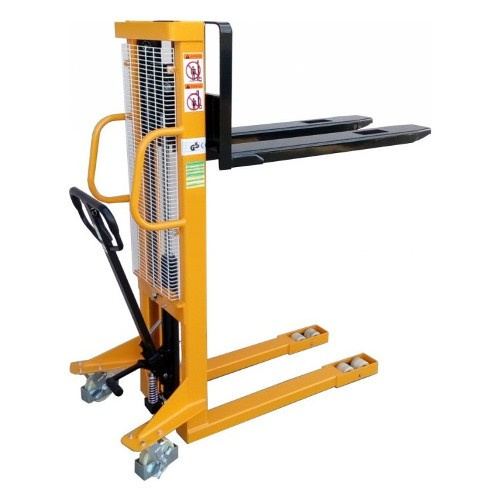
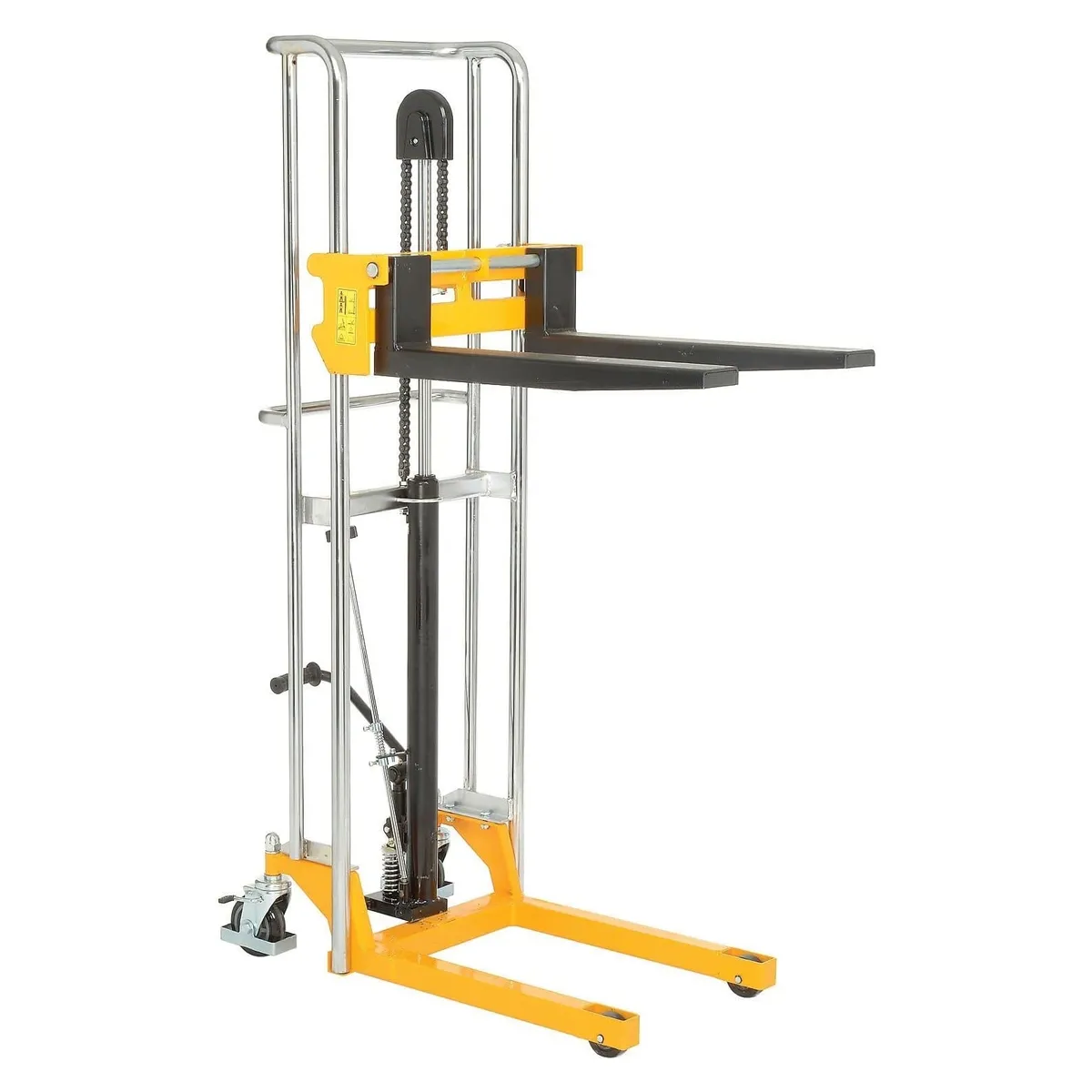
The semi-electric stacker powers the part that hurts — the lifting — while travel stays manual: the most economical entry into powered stacking for operations that lift regularly but travel short distances. The range covers the PEVV10/PEVV15 warehouse stackers (1000–1500 kg, up to 3500 mm), the PEVV15-PV pallet stacker and the straddle version PEVV-DPV with adjustable legs for closed pallets.

Below sit manual stackers for occasional lifts; above, full-electric models once travel distances grow. Contact us with your daily cycle count and we will confirm which class pays off.

Frequently asked questions

Semi-electric or manual stacker?

Count the lifts: pumping a 1000 kg pallet to 3 m takes real time and effort. If stacking happens more than a few times per hour, the powered lift of the semi-electric class pays for itself in operator time and consistency.

Semi-electric or full-electric?

The dividing line is travel: with short distances (one hall, adjacent racks) manual pushing is fine and semi-electric saves money. Once the stacker travels tens of metres per cycle, powered drive — full-electric — wins.

How quickly can a semi-electric stacker be delivered?

Request a quote on the product page with the capacity and lift height and we will confirm availability, the current lead time and the delivery cost for your location.