
















Back to catalog
Rack and Pinion Jacks
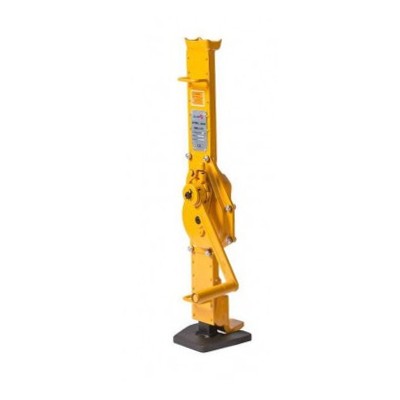
Rack and pinion jacks (steel lifting jacks) for assembly work, securing and supporting heavy loads, with top head and bottom toe claw lifting positions.


How to choose
What it is for
- Mechanical jack for lifting and lowering heavy loads over short heights from below.
- Positioning machines, rail, construction props.
Check before you choose
- Capacity at head and at toe
- Lift height
- Base stability
Not suitable for
- Lifting from above
- Holding loads without securing
What we will ask you before recommending a model
Rack and pinion jack Standard selection — the parameters above are enough to choose the right model.
- Capacity, initial clearance, stroke, lifting on head or toe (claw), flatness/hardness of the ground, lever access? Head and toe capacity may differ; the jack is not a permanent support.
Typical mistakes to avoid
- A jack is not a permanent support — the load must be propped before anyone works under it; check head vs. toe capacity.
Helpful to have ready: Mass/shape · Initial height · Stroke · Number of points · Photo of the ground
Rack and pinion jacks
A rack and pinion jack (steel lifting jack) is the classic tool for lifting, supporting and precisely positioning heavy loads close to the ground — machinery during installation, structures during alignment, vehicles and equipment in the field. Unlike hydraulics it holds the load mechanically on the gear train, works in any position and needs no fluid, seals or pumping. The MKD range spans 1500 kg through 5000 kg up to 20 000 kg.
Each jack lifts in two positions: on the top head, and on the bottom toe (claw) that slips under loads with only a few centimetres of clearance — the feature that makes these jacks irreplaceable when there is nowhere to place a hydraulic cylinder. For pulling and tensioning tasks see pulling hoists and lever hoists; for vertical lifting from above, manual chain hoists. Contact us with the load and available clearance and we will size the jack.
Frequently asked questions
What is the advantage over a hydraulic jack?
The rack and pinion mechanism holds the load mechanically — no seals to leak, no fluid to service — lifts in any orientation and lowers under full control. The bottom toe also reaches under loads with minimal ground clearance, where hydraulic cylinders often cannot fit.
What does the toe (claw) capacity mean?
The load rating differs between the top head and the bottom toe — the toe typically carries less because of the lever geometry. Each model's documentation states both figures; size the jack by the position you will actually lift from.
Can several jacks lift one load together?
Yes, that is common practice for machinery — but the load must be distributed so no jack exceeds its rating, and the crew must raise the jacks evenly to keep the load stable. Plan the lift so the centre of gravity stays inside the support pattern at every step.
How quickly can a rack and pinion jack be delivered?
Request a quote on the product page with the capacity you need and we will confirm availability, the current lead time and the delivery cost for your location.