Delacco
+385 91 25 50 100 sales@delacco.com
Final testing phase: this online store is being tested. Quotations and orders generated during this period are provisional — our team will personally confirm each one by email before anything becomes binding.
Back to catalog

Full Electric Stackers

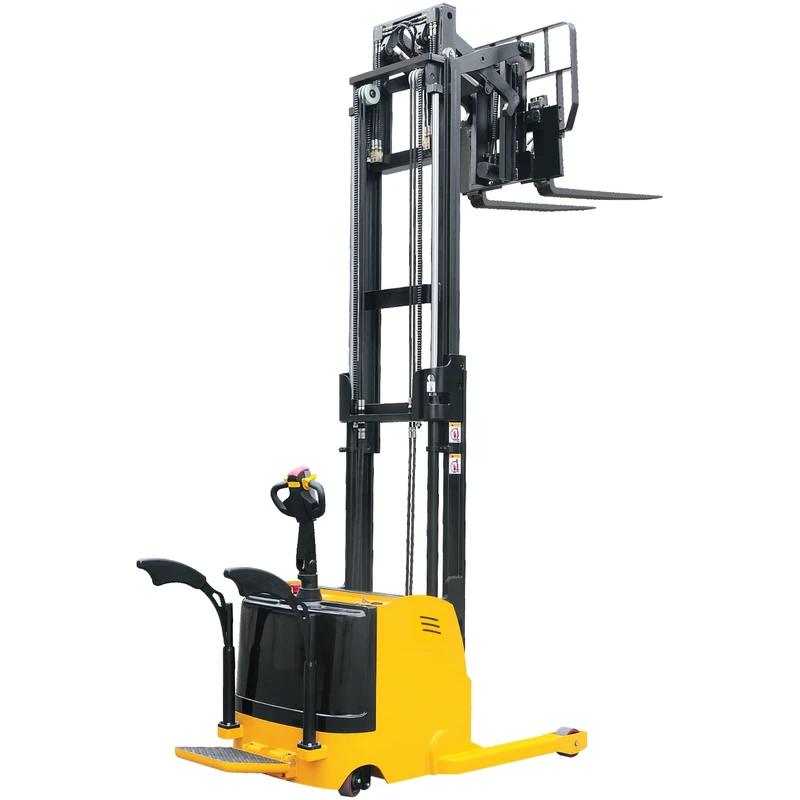
Full-electric stackers with powered drive and lift for effortless pallet stacking, ideal for medium-intensity warehouse duty.
9 products

How to choose

What it is for

  1. Electric lift and travel: the workhorse for stacking EUR pallets to 1.6–5.6 m in production and warehouses.
  2. Truck loading via dock, replenishment, machine feeding.
  3. Rider versions for longer distances.

Check before you choose

  • Weight vs. lift height (residual capacity)
  • Straddle version for closed pallets
  • Walkie vs. rider platform
  • Battery and charger
  • Mast type (free lift for low ceilings)

Not suitable for

  • Rough or outdoor floors
  • Loads above ~2 000 kg

What we will ask you before recommending a model

Full electric stacker Technical check — we confirm a few parameters and compatibility with you before the order.
  1. Heaviest load including pallet, packaging and any attachment? Rule of thumb: use at most 80 % of rated capacity for safety and service life.
  2. Dimensions (L×W×H) of the largest and of the heaviest load? Is the centre of gravity known and centred? The load centre moves away from the mast as the load gets longer; real capacity falls with load-centre distance and lift height (capacity diagram). Tall loads raise the COG.
  3. Is the load always on a EUR pallet (open bottom)? Or CHEP / closed-bottom / plastic pallets, boxes, or goods placed directly on the forks? Dimensions of the pallet underside? Forks with support legs underneath need an open-bottom pallet. Goods without a pallet load the forks at points and bend them. Pallet compatibility matters more than capacity.
  4. How high must the load be lifted — top rack beam, vehicle bed, machine table? How many rack levels? Capacity at maximum height is much lower than nominal (residual capacity). Customers know 'the rack', not millimetres — ask them to measure the top beam.
  5. Lowest passage in the working area (doors, beams, pipes, mezzanine, container, lift)? Ceiling height where stacking happens? Lowered mast height must pass every obstacle; extended mast must fit under ceiling, lighting and sprinklers.
  6. Aisle width between racks and the narrowest passage / door? Every truck has a stacking-aisle width (Ast). Compare with Ast, not with the truck width.
  7. What is the floor: industrial concrete, asphalt, paving, gravel, uneven, potholes, sharp edges, expansion joints, thresholds, drains? Small polyurethane wheels and no suspension: tolerance for unevenness is very low. Sharp edges cut the PU tread; gaps stop the small load rollers.
  8. Are there gradients (ramps, slopes) in the working area? How steep (%) and how long (m)? Pedestrian and stand-on trucks are designed for level floors; motor, brakes and drive-wheel traction are sized for occasional short ramps. On a long or steep slope they overheat, lose traction or cannot hold the load.
  9. How long must the truck run continuously, how many hours per day and shifts? Pallets per hour, distance per trip? Battery capacity and truck class follow from this. Most buyers under-specify on price and end up with a truck that stops mid-shift.

Typical mistakes to avoid

  • Nominal capacity is not enough — confirm residual capacity at the actual height and COG (load chart).

Helpful to have ready: Pallet · Mass/COG · Height · Aisle (Ast) · Doors/ceiling · Gradient · Route · Shifts · Charging voltage

How to choose a full-electric stacker

A full-electric stacker powers both travel and lift, so one operator stacks pallets all shift without touching a pump handle — the natural step up once stacking becomes a continuous part of the workflow rather than an occasional task. Selection comes down to capacity, lift height, pallet type and how far the truck travels per cycle. The walkie range covers the EVV10/EVV12/EVV15 (1000–1500 kg, up to 5600 mm) and the economical EVV-B models (up to 3500 mm).

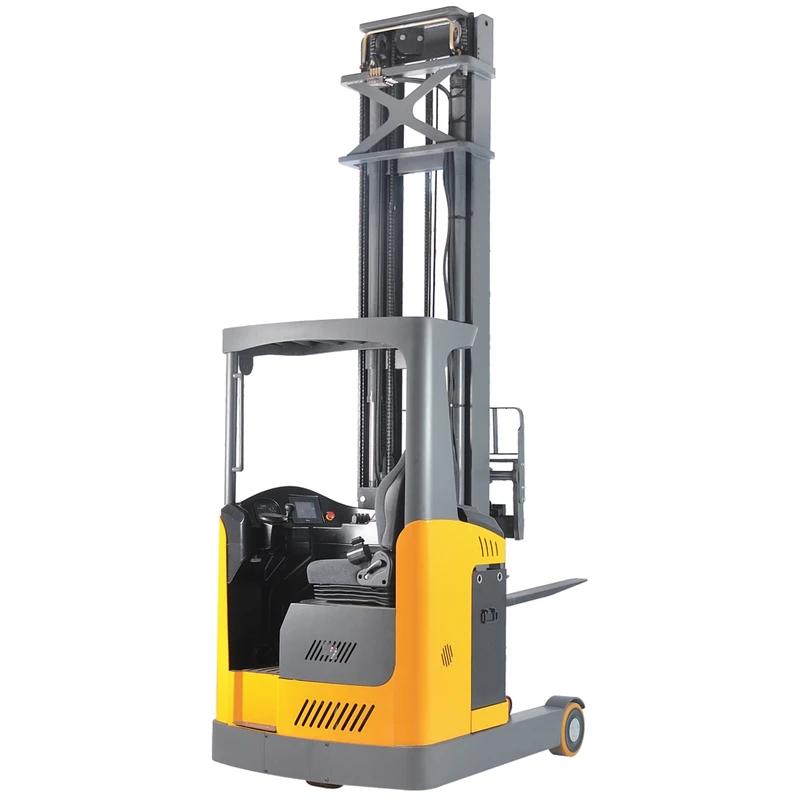
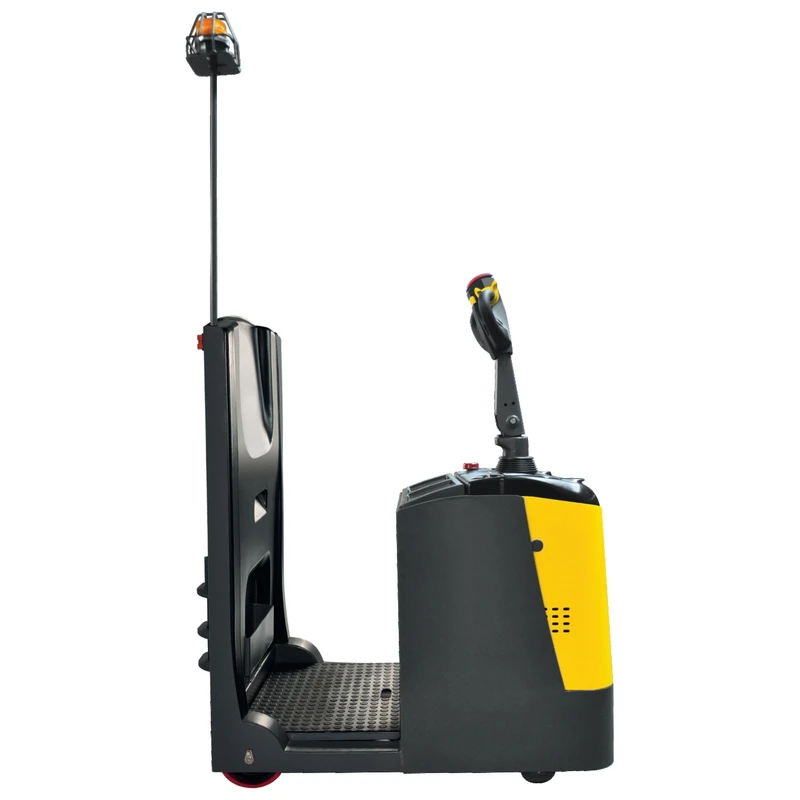
For closed and non-standard pallets, straddle versions — walkie EVV-PV and rider EVV‑PV‑P — embrace the pallet between adjustable legs. Long transport distances call for rider models like the EVV20-P (2000 kg, up to 6500 mm). Occasional duty is cheaper with semi-electric or manual stackers; heavier racking work moves up to counterbalanced stackers, reach stackers or a reach truck. Contact us with pallet type, weights and target beam heights and we will pick the model.

Frequently asked questions

What capacities and lift heights do full-electric stackers cover?

The EVV programme covers 1000 to 2000 kg with lift heights from 1600 up to 6500 mm depending on the model. Capacity typically reduces at height — check the load diagram on the product page against your top beam level and heaviest pallet.

When do I need a straddle stacker?

When your pallets are closed, bottom-boarded or non-standard: the straddle legs adjust in width and embrace the pallet, so the forks do not need free space underneath. For standard open Euro pallets the regular models are simpler and cheaper.

Walkie or rider stacker?

Walkie models suit short runs and mixed duties. Rider platforms pay off when transport distances grow — the operator rides at higher speed instead of walking — typically from around 30–40 m per cycle upwards.

Full-electric stacker or reach truck?

A stacker is the economical choice for stacking up to roughly 5–6 m in low-to-medium intensity duty. A reach truck adds residual capacity at height, faster cycles and cab comfort for full-shift racking work — at a correspondingly higher price.

How quickly can a full-electric stacker be delivered?

Request a quote on the product page with the mast height and battery preference and we will confirm the current lead time, delivery cost and commissioning support for your location.