














When a pillar jib crane is the right choice
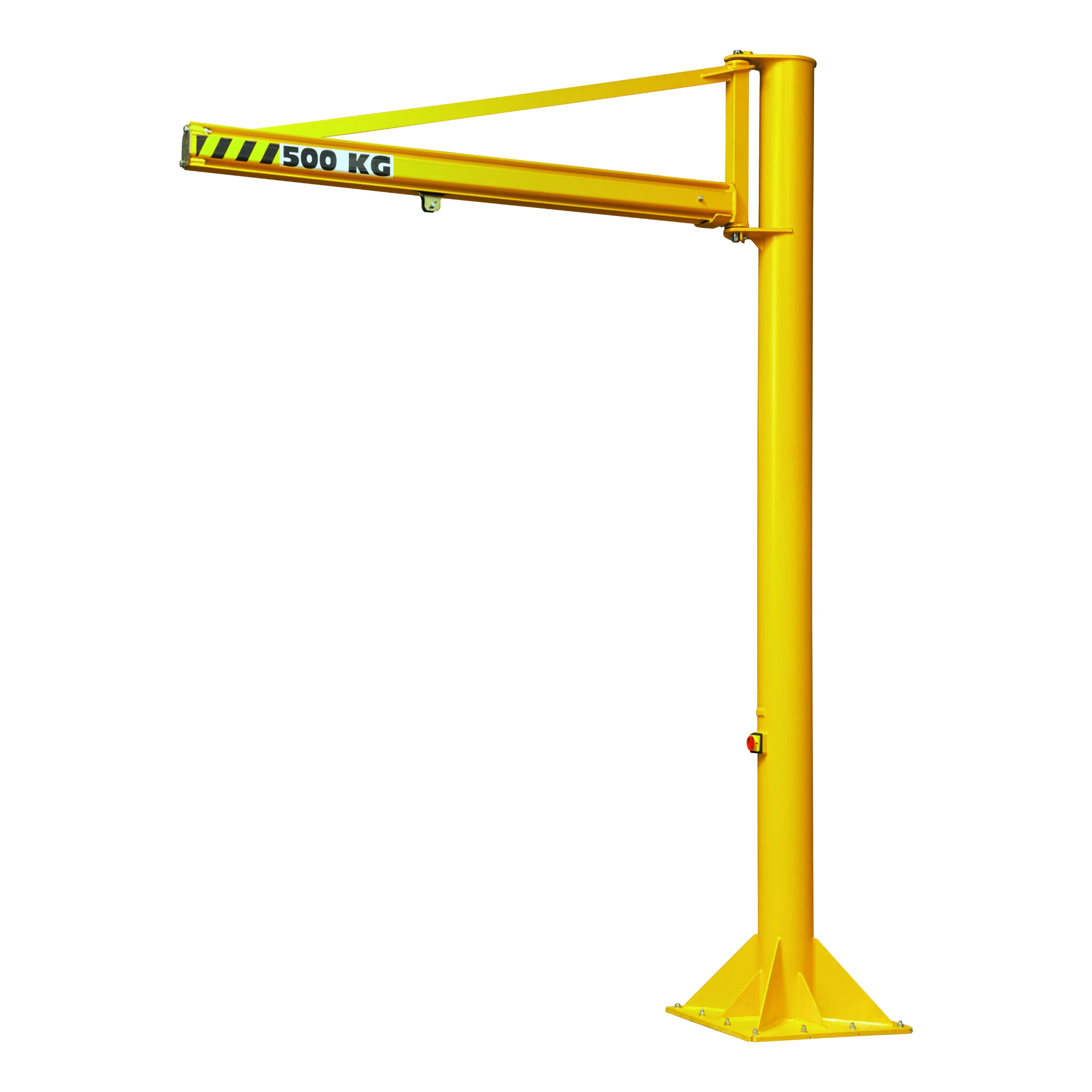
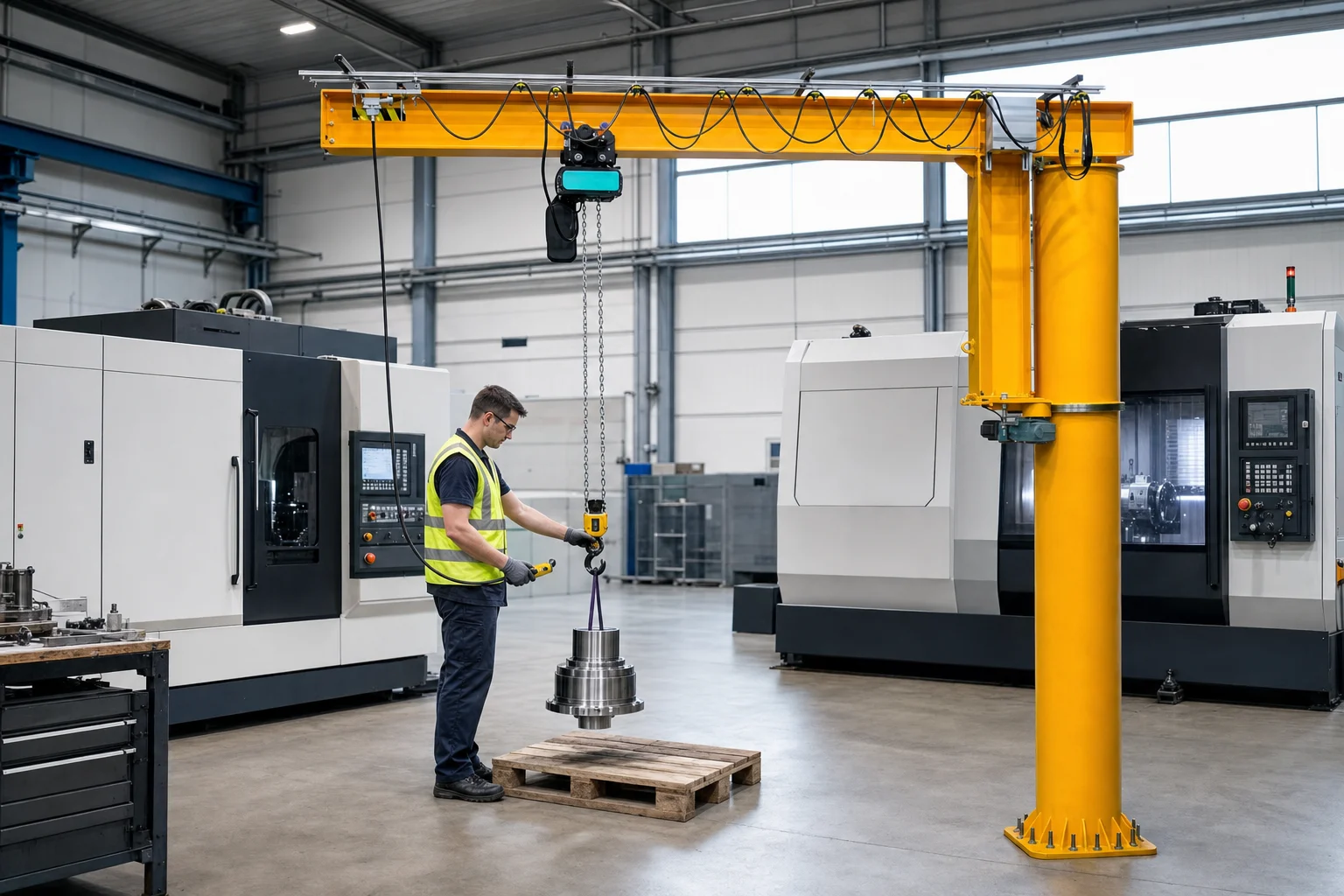
A pillar jib crane (also called a column or free-standing jib crane) stands on its own floor-anchored column, so it works anywhere a foundation can be poured: in the middle of a hall, between machines, on a loading yard outdoors. The boom slews around the column and covers most of a full circle — no walls or building steel needed. That independence is what you pay for: the pillar and its foundation are the cost difference against a wall-mounted jib crane, which is why the wall version wins whenever a strong wall already stands next to the workstation.
This guide covers the decisions specific to pillar cranes: partial (270°) versus full (360°) rotation, capacity and boom length, boom construction, foundations, and when motorized slewing makes sense. Every crane below is made to order in the EU and delivered CE-marked.
1. The first decision: 270° or full 360° rotation
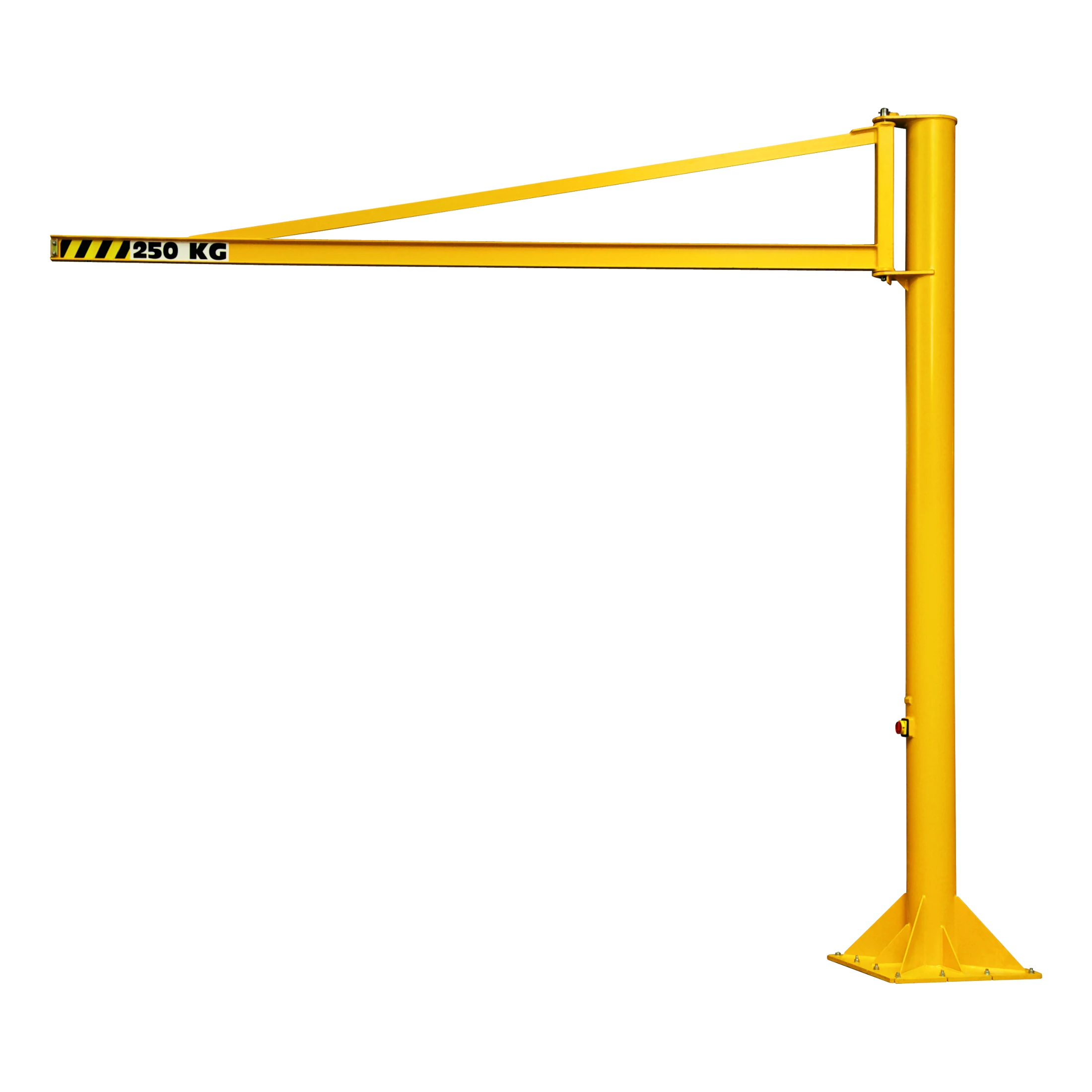

Standard pillar cranes slew 270° — the slewing stop is by design, and for a workstation against a wall or a machine you never miss the blocked quarter. Choose 270° whenever the crane serves one side of its circle; it is the simpler and cheaper machine.
Choose the full-rotation RSD (360°) when the crane stands truly free — feeding several machines around it, unloading vehicles on more than one side, or serving a circular work area. The RSD covers 150–10,000 kg with spans of 2–12 m (0.5 m steps), far beyond the standard models, with a 4-ring electrical collector available so the boom can rotate endlessly without twisting the hoist cable, plus optional slewing limit switches and adjustable rotation stops where the arc must be restricted. Height under beam is 3 m as standard, adjustable in 0.1 m steps to 4 m (higher on request), and it is built for indoor and outdoor use.
2. Manual or motorized slewing
Up to roughly a tonne and a few metres of boom, pushing the load around by hand is easy — the slewing bearings are the same on every model. As capacity, span and cycle counts grow, slewing a loaded 8–12 m boom by hand stops being reasonable. The RSD offers optional slewing motorization: driven at the main roller for indoor cranes or top-mounted for outdoor installations, controlled from the same pendant as the hoist. If operators will slew heavy loads many times an hour, plan the motorization from the start — it determines the electrical package.
3. Capacity and boom length
Size the crane to the heaviest load plus the hoist and trolley weight, and measure the boom against the real pick-up and set-down points. Capacity and span work against each other structurally: both drive the pillar section, the foundation and the price. As orientation, the SDS and NSD cover 150–2,000 kg with booms to 7–8 m; above that (to 10 t and 12 m) the RSD takes over. Deflection under nominal load is engineered to about 1/250 of span plus height — a stiff crane, not a springboard.
4. Boom construction: overbraced, underbraced, hollow-profile, aluminum
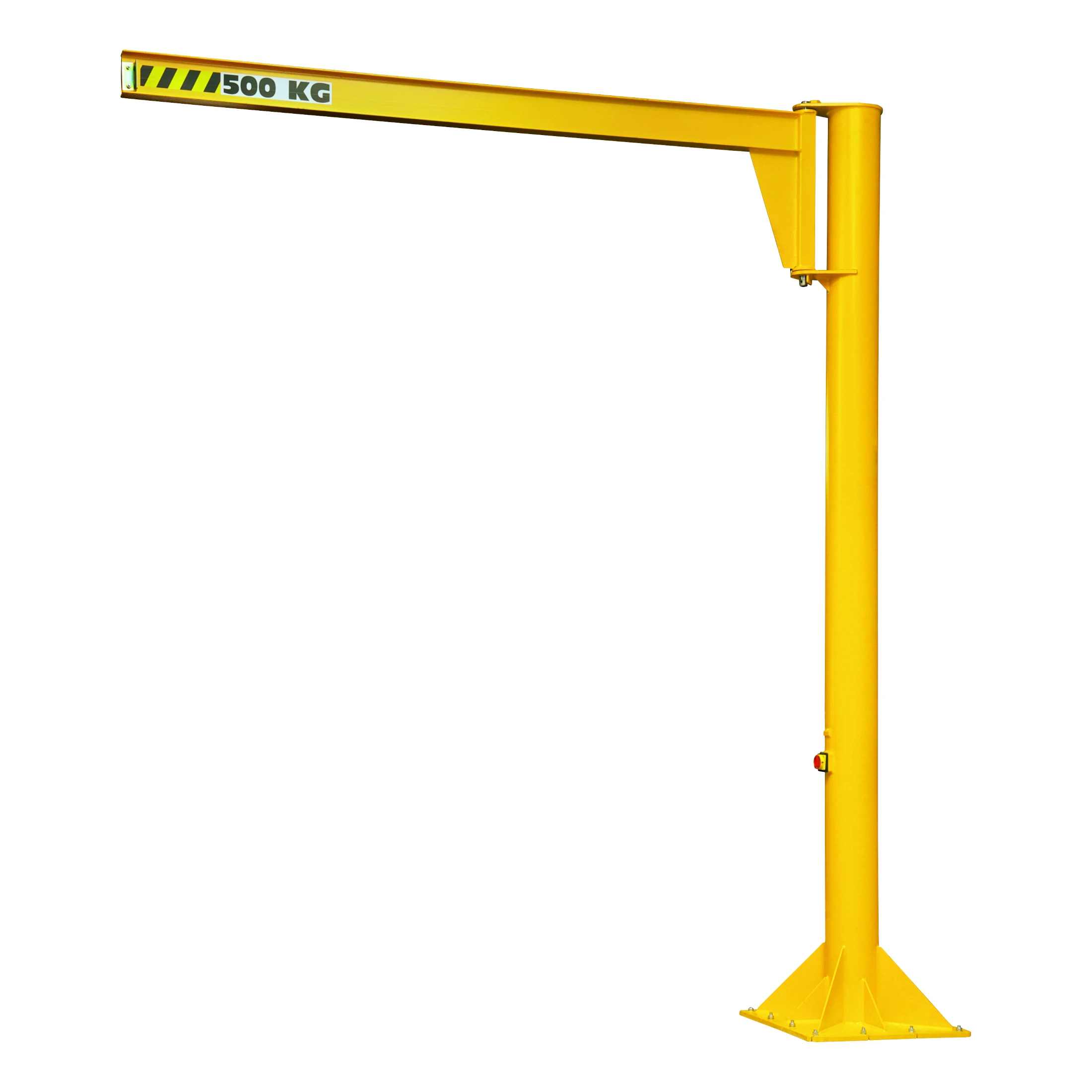
- Overbraced (SDS, from €1,377) — brace above the I-beam, maximum stiffness for the money; the workshop default.
- Underbraced (NSD) — brace below, flat top: fits under low ceilings and the trolley travels the entire boom.
- Hollow-section boom with integrated trolley (SDSK, 50–1,000 kg) — the trolley runs inside a closed profile: smooth low-effort travel, no open flange collecting dirt. A compact NSDK version covers light 50–100 kg stations.
- Aluminum rail (ASDS, 63–2,000 kg) — moving the hoist by hand takes a fraction of the effort of steel; operators feel it every cycle. For 50–100 kg workstations the LSDS light pillar crane is the entry point.
5. Articulated booms: reaching around obstacles
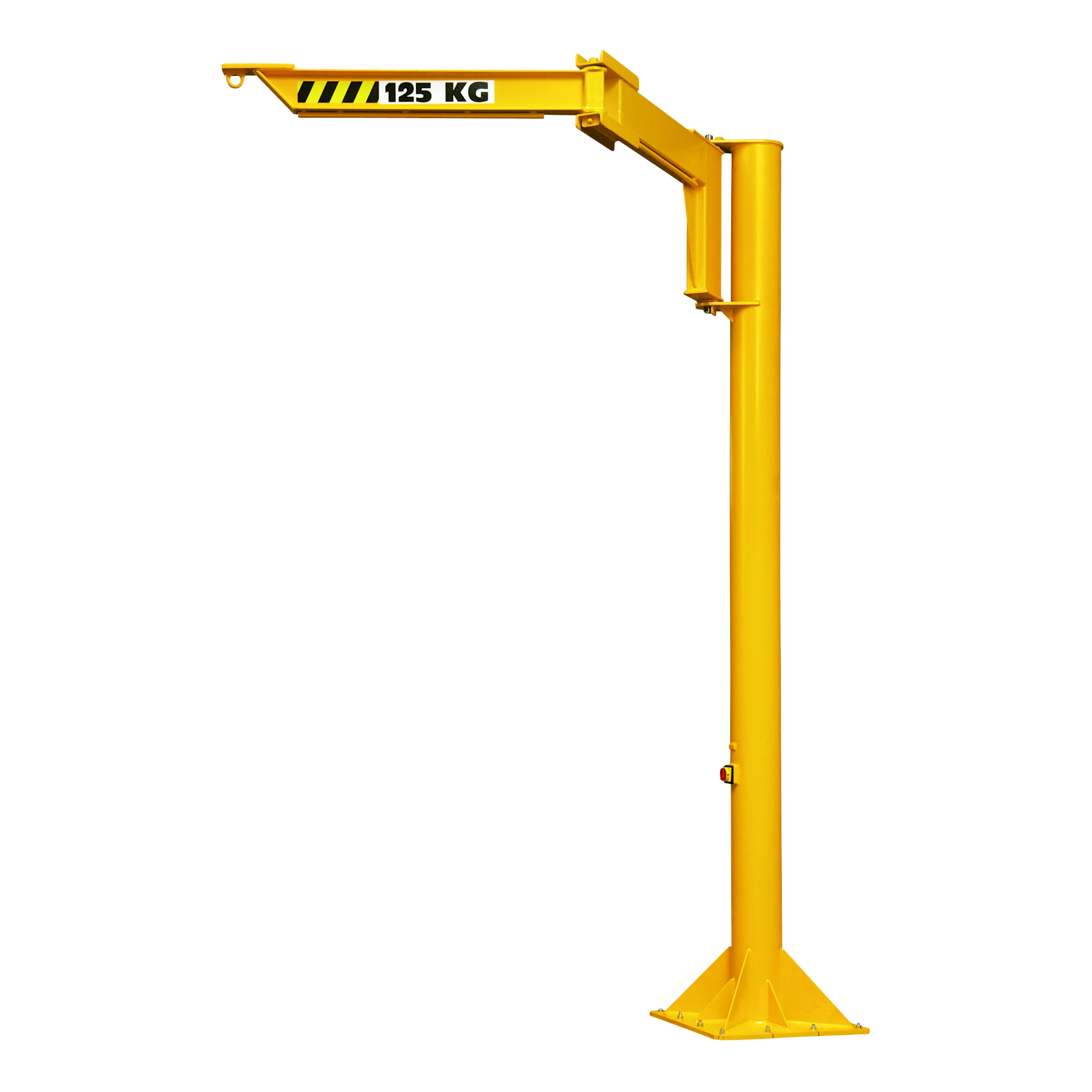
A straight boom sweeps a simple arc. An articulated pillar crane (ZSD, 125–500 kg) has two hinged arms — the first slews 270°, the second 300° — so the hoist reaches around columns and machine frames, through openings, and right up to the pillar where a straight boom cannot go. For serving the inside of machine tools, presses and CNC enclosures it is usually the only geometry that works. Variants: ZSD-S (50–1,000 kg) and the suspended ZSD-PS, which hangs the articulated arm pair from above.
6. Foundation and fixation
Every pillar crane transfers its tipping moment into the floor, so the foundation is part of the machine. Two standard methods: a cast-in installation template with anchor rods (set into fresh concrete before the crane arrives), or a bolt-down splitable base plate with a chemical-anchor kit for existing quality floors. We supply the anchor plan and foundation drawing with every order — your contractor prepares the foundation, the crane bolts on top. For outdoor cranes the finish steps up from the standard C2 powder coat to a C3 paint system.
7. Hoist, trolley and the complete package
Configure the crane and the hoist together: a manual chain hoist for occasional lifts, or a GP electric chain hoist with a beam trolley for anything repetitive (our electric chain hoist guide covers capacity, speed and duty class). Ordered together, the trolley is matched to the boom profile and the crane arrives ready to install. A dedicated 50 kg welding support stand (SDAP) exists for carrying torch and cable packages instead of a hoist.